Writing · · 5 min read
Research is a love affair with the unknown
An Ecology of Ways of Knowing
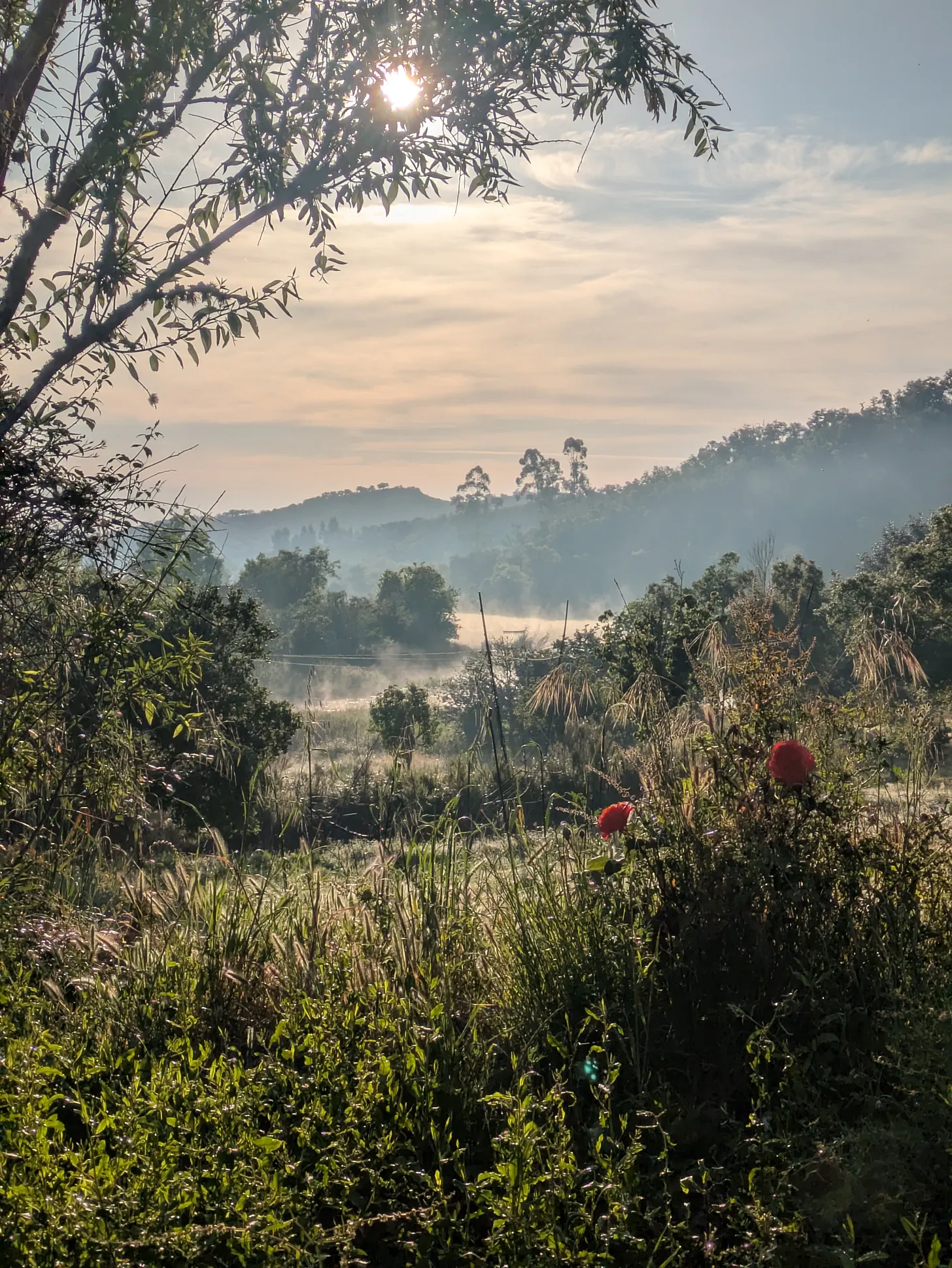
I found my way into a Love School in Tamera, a peace research community in a surprisingly lush part of southern Portugal.
For 30 years, they have cultivated alternative ways of loving, learning, and living. As one of the longest-lasting intentional communities of its kind, I was curious - what enables such a unique project to endure? In their view, one key element in building lasting communities is to resolve tension around often unspoken topics - love, sex, money and power. Taboos are where the deepest potential for evolution lies.
That's the purpose of Love Schools: to consciously name and examine the dynamics and patterns that usually unfold unconsciously. At Tamera, love was explored not just as a private matter, but as a political issue. "There can't be peace on Earth as long as there's war in love." This resonates deeply with my experience. Relationships are often fertile ground for conflict, even when that's the opposite of what we intend to create. One of the most potent ways to create more harmony in our world is to practice living love in a nourishing, sustainable way. This requires deep work - a commitment to regenerating trust, balancing freedom with care, and practicing ways of being with fear and insecurity so that it can evolve into transparency.
What inspired me most about Tamera wasn't the ethical non-monogamy or the radical transparency. It was seeing how life was treated as an ongoing research project. Everyone carried a unique question that they explored over months, sometimes years. How do I love freely, without losing myself, without fear? What would it look like to learn from and with animals? As part of this exploration, they coexist with wild boars and have even built temples to rats. During my time at Tamera, my own encounters with the boars shifted from fear to a relaxed, neighborly dynamic.
This immersion in living-as-research shifted something in me. Even the word itself, "research", suddenly felt alive again. Relevant, not dry. Rescued from the realm of white coats and sterile labs, returned to its original roots: to seek.
Cultivating a private research practice is quite revolutionary. It means reclaiming power over what counts as knowledge.
It's a declaration of sovereignty: I, too, can create knowledge. It means honoring the legitimacy of insight born from our own lives. This feels radical in a world that tells us knowledge belongs to specialists. That real insights come from laboratories, not from the beautiful chaos of daily existence.
For centuries, we've worshipped only one type of knowing: proven facts and scientific discoveries. This form of research has given us incredible gifts. And it has come with a price - we've forgotten and dismissed other ways of knowing. The intelligence of the body. The wisdom that emerges through relationships. The knowing that comes from observing other life forms evolve, move, adapt.
I'm not suggesting we dismiss science - it's about expanding our definition of legitimate knowledge. To reclaim our sovereignty and strengthen our ability to pay attention - rather than outsourcing knowledge creation to a single source. To cultivate an ecology of ways of knowing, instead of a flattened monoculture. Monocultures die; diversity is where resilience emerges.
Diverse forms of knowing become even more crucial as AI reshapes our relationship with knowledge. Our unique perspective - how we make sense of this moment, in this body, with this history - is what can't be automated, replaced.
Cultivating this attunement and diversity might require dissolving certain binaries that no longer serve us. Seeing science and mysticism as complementary, not opposites. In fact, scientific breakthroughs are often described as moments of intuitive insight, sudden knowing that transcends logical analysis. And contemplatives have been conducting extremely rigorous experiments in consciousness for millennia. Both ways are animated by the same impulse - wonder, curiosity, a deep longing for truth. Seeking understandings through measurement and analysis, through direct experience and inner exploration. Both are necessary for a richer picture of reality.
Research, at its heart, isn't an academic discipline.
It's a love affair with the unknown.
A willingness to be surprised by Life.
A practice of treating each day
as an opportunity to explore
the mystery of what it means
to be alive, now.
Always with curiosity,
Laura
Receive new writing
Free essays in your inbox, with the option to support the work as a paid subscriber.